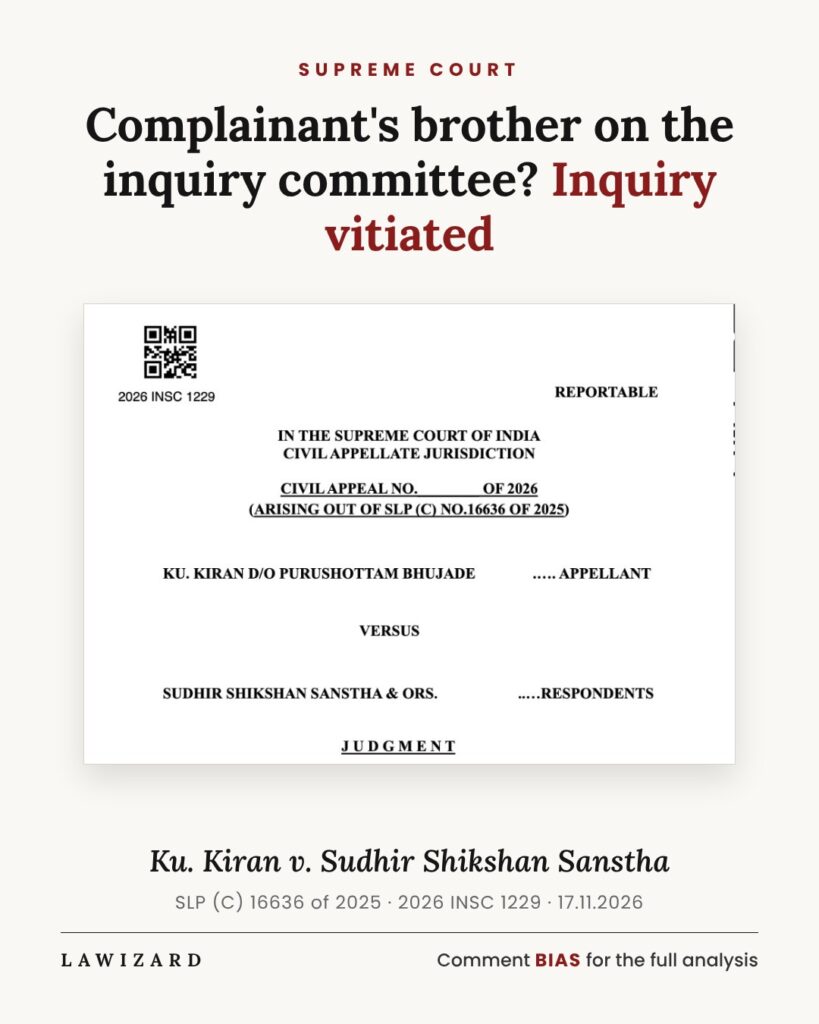
A school teacher is charged with misconduct. The complainant, the prosecutor and the main witness is the Secretary of the society that runs the school. The Convenor of the inquiry committee is his real brother. The committee finds her guilty and she is dismissed. In Ku. Kiran v. Sudhir Shikshan Sanstha, the Supreme Court has set the inquiry aside. She did not have to prove that the Convenor was actually biased. A reasonable likelihood of bias, as a fair-minded person would see it, was enough.
Case at a glance
- Case: Ku. Kiran D/o Purushottam Bhujade v. Sudhir Shikshan Sanstha & Ors., Civil Appeal arising out of SLP (C) No. 16636 of 2025
- Citation: 2026 INSC 1229
- Bench: Justice Manoj Misra and Justice Manmohan (judgment by Justice Manmohan)
- Decided: 17 November 2026
- Law: Rule against bias (natural justice); Rule 36 of the Maharashtra Employees of Private Schools (MEPS) Rules, 1981
- Result: Appeal allowed; Bombay High Court (Nagpur Bench) judgment set aside; School Tribunal order of 21 March 2024 (reinstatement with continuity and full back wages) restored
The facts
The appellant was appointed an Assistant Teacher in 2009 in a school run by Sudhir Shikshan Sanstha. After a 2016 Government Resolution gave the school 20% grant-in-aid, she alleged that the Secretary left her name out of the salary grant bills, and in 2021 she complained to the Education Minister and other authorities. A show-cause notice followed, alleging misconduct including tampering with documents.
The Sanstha set up an inquiry committee under Rule 36 of the MEPS Rules. Its Convenor, Prakash Masurkar, was the real brother of the Secretary, Rajesh Masurkar, who was the complainant, the prosecutor and the principal witness. On eleven of the twenty charges, the Secretary was the only witness. She objected to the Convenor on the ground of bias. The committee found her guilty by a 2-1 majority, and she was terminated in 2022.
How it went through the courts
- School Tribunal, Nagpur: quashed the termination in 2023. After a remand by the High Court, it quashed it again on 21 March 2024, calling the proceedings “a farce of enquiry”, and ordered reinstatement with full back wages.
- Bombay High Court, Nagpur Bench (29 April 2025, Writ Petition No. 4965 of 2024): upheld the termination. It took the view that no one had acted as a judge in his own cause, mixing up the two Masurkar brothers.
- Supreme Court (17 November 2026): allowed her appeal.
What the Supreme Court held
1. Actual bias need not be proved
“The test is not whether actual bias is proved, but whether there exists a ‘reasonable likelihood of bias’ or ‘real possibility of bias’, in the mind of a reasonable person as distinguished from a merely fanciful apprehension” (para 49). The Sanstha’s argument that she had to prove a specific instance of bias was rejected.
2. Close kinship can disqualify
A relationship close enough to create a reasonable likelihood of bias disqualifies an adjudicator. The same approach applies to courts and to administrative and domestic tribunals.
3. “Total familial capture” of the inquiry
One brother complained, prosecuted and gave the evidence; the other convened the committee and accepted that evidence. The separation between the prosecutor and the judge collapsed.
4. A fair procedure cannot cure a biased tribunal
Many hearings, examination of witnesses and cross-examination do not cure a defect in who sits on the committee.
5. No necessity, no waiver
The doctrine of necessity did not apply, since two unrelated Executive Committee members were available. Nor had she waived the objection: a waiver must be voluntary, informed and unequivocal, and the majority report itself recorded and rejected her objection.
6. Relief
The School Tribunal’s order of 21 March 2024 was restored. The Education Officer was directed to consider absorbing her in another 100% grant-in-aid school under Rule 26(2)(iii) of the MEPS Rules.
Why it matters
- For employees facing a departmental inquiry: object to a biased member in writing at the start. You need to show a reasonable likelihood of bias, not proof of actual bias.
- For employers and managements: keep the complainant, his relatives and the witnesses off the inquiry committee. A tainted committee can undo years of proceedings and lead to full back wages.
- For law students: a clean modern application of A.K. Kraipak, Ranjit Thakur and Pinochet (No. 2): nemo judex in causa sua.