When the State decides whether to release a life convict early, the victim’s family has a say. The Supreme Court has held that a victim who is identifiable and traceable, or the victim’s legal representative, must be given notice and a reasonable opportunity to submit a representation before a decision on premature release (remission) is taken. The victim gets a voice, not a veto. Applying this, the Court quashed the 2023 premature release of former MP Anand Mohan, convicted for the 1994 mob killing of Gopalganj District Magistrate G. Krishnaiah, and struck down Bihar’s amendment that had made his release possible.
Case at a glance
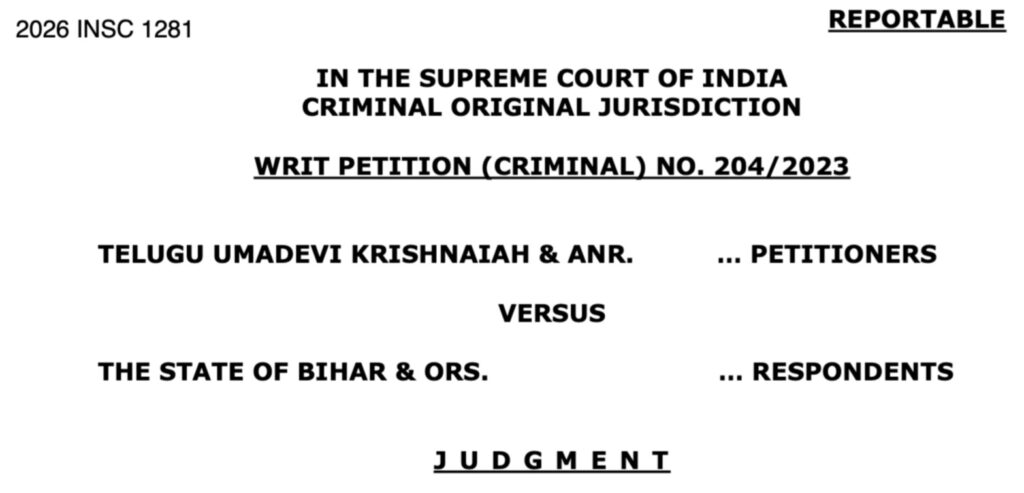
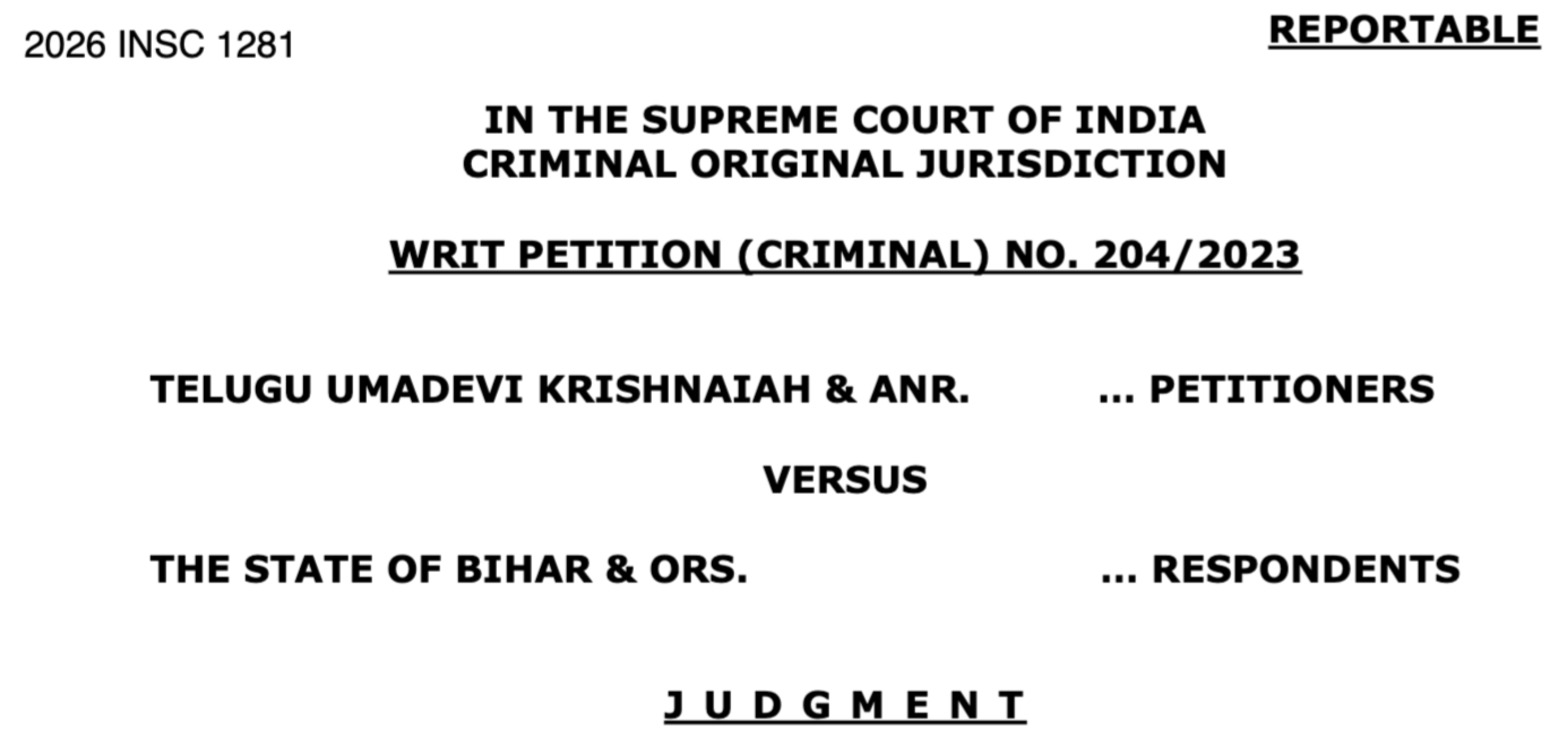
- Case: Telugu Umadevi Krishnaiah & Anr. v. State of Bihar & Ors., Writ Petition (Criminal) No. 204 of 2023
- Citation: 2026 INSC 1281 (Reportable)
- Bench: Justice Dipankar Datta and Justice Sheel Nagu (judgment by Justice Datta)
- Decided: 26 November 2026
- Petitioner: the widow of the slain IAS officer G. Krishnaiah
- Result: writ petition allowed; Bihar’s notification of 10 April 2023 set aside; Anand Mohan’s premature release of 24 April 2023 quashed; he must surrender within one month
The victim’s right to be heard
The Court noted that the victim’s participation is now recognised at the stages of investigation, trial, appeal and bail, and asked why it should vanish when the State considers ending a convict’s sentence early. It answered:
“The victim’s participation in the criminal justice process cannot be regarded as having exhausted itself merely upon the conclusion of the trial and the imposition of sentence.”
In para 47 it held that an opportunity for the victim “who is traceable and identifiable, to at least submit a representation ought to be read into the Prison Manual”. The authority must, wherever practicable, give notice to the victim or the victim’s recognised legal representative, allow a reasonable opportunity to submit a representation before deciding, and give that representation due consideration as one of the relevant inputs.
The Court was clear about the limits: the victim does not decide the outcome. Participation “does not confer a veto over the State’s decision”, and the competent authority must still decide independently, under the law and the remission policy.
Bihar’s 2023 amendment struck down
Since 2002, Rule 481(i)(a) of the Bihar Prison Manual had kept persons serving life for the murder of a public servant on duty out of the ordinary remission scheme. On 10 April 2023 the State deleted the words “or for murder of a public servant on duty”, and Anand Mohan was released on 24 April 2023. The Court held that the amendment was a sudden and selective departure from a consistent policy, “without any discernible public purpose, empirical basis or material demonstrating a bona fide change in correctional policy”, and declared it manifestly arbitrary and violative of Article 14. It also found that the State had relied on a 2021 opinion of the Presiding Judge instead of a fresh, reasoned opinion under Section 432(2) CrPC.
The directions (paras 91-93)
- The notification of 10 April 2023 is declared unconstitutional, invalid and inoperative, and set aside.
- The order of 24 April 2023 granting premature release to Anand Mohan is quashed.
- He must surrender before the prison authority within one month, failing which he is to be taken into custody.
- The State may reconsider premature release afresh in line with the judgment, but may not start any process to revise Rule 481 before he surrenders or is taken into custody.
- In any fresh consideration, the widow must get a reasonable opportunity to submit a representation, which must be duly considered.
Article 21 protects the victim too
In its epilogue the Court said that in remission matters Article 21 “cannot be read as a guarantee tilted in favour of one side”. It protects not only a reformed convict but also the victim, or the victim’s family, and their right to a life of dignity and freedom from fear.
Why it matters
- For victims and families: before a convict is released early, you can ask to be heard and place your concerns (safety, threats, the impact of the crime) before the authority.
- For State governments and prison authorities: remission files should now record notice to the traceable victim and consideration of the representation. Policy changes that benefit a particular convict will face close scrutiny.
- For law students: a significant extension of victim participation (building on Jagjeet Singh v. Ashish Mishra) into the executive stage of remission under Section 432 CrPC / Section 473 BNSS.