Bare Act · Complete · As on 10 January 2026
The Code of Civil Procedure, 1908
ACT NO. 5 OF 1908 · [21st March, 1908]
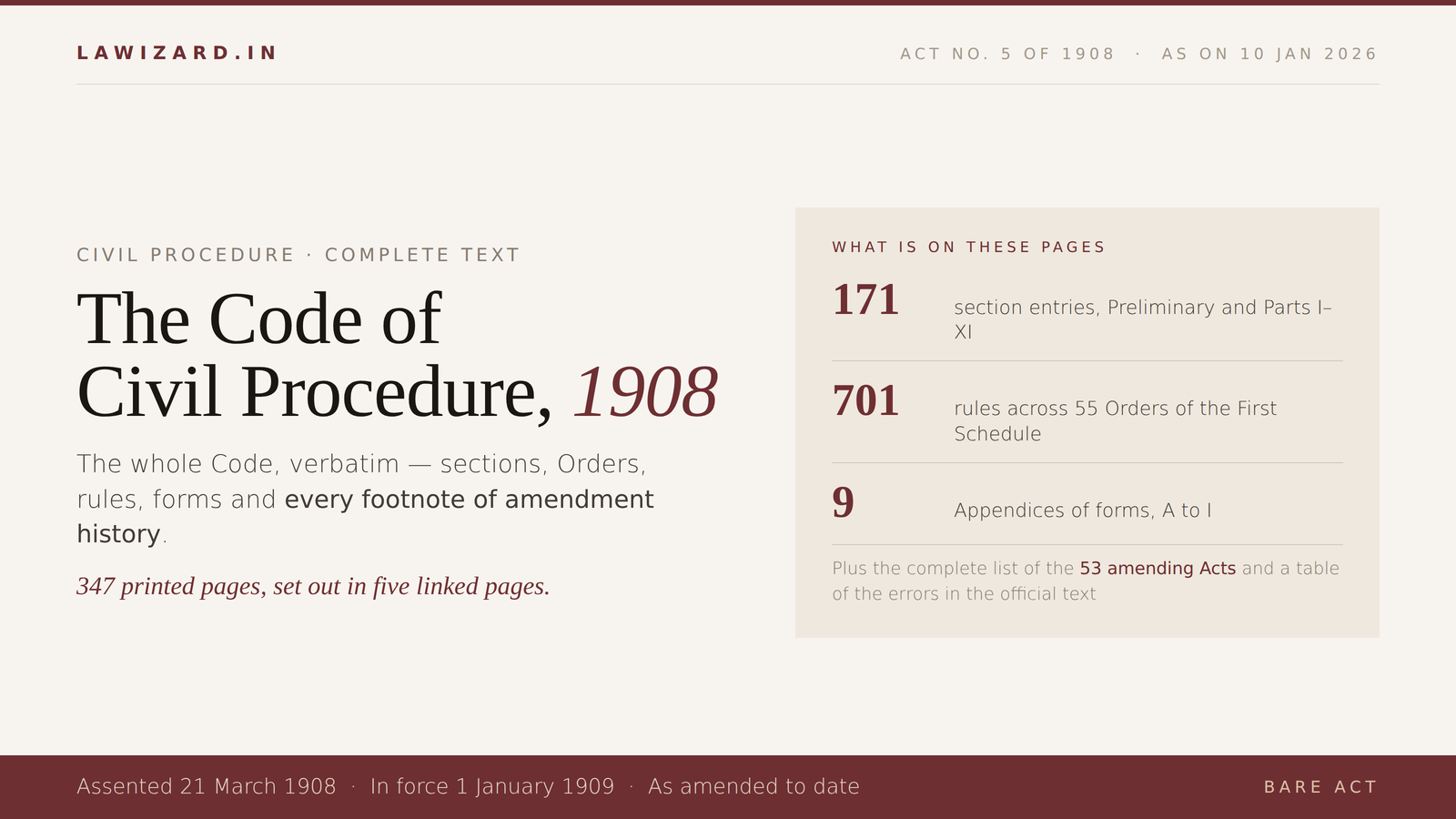
The whole Code, verbatim: sections 1 to 158, the First Schedule with all 55 Orders and 701 rules, and every form in Appendices A to I. Nothing paraphrased, nothing abridged, and every footnote of amendment history kept where the official text puts it.
Because the Code runs to 347 printed pages, it is set out here in five pages rather than one, so that each loads quickly and each can be linked to on its own. The index below covers all five.
The Code in six parts
Index & hub ← you are here
The Code at a glance
| Short title | The Code of Civil Procedure, 1908 |
| Act number | Act No. 5 of 1908 |
| Date of assent | 21 March 1908 |
| Commencement | 1 January 1909 (section 1(2)) |
| Long title | An Act to consolidate and amend the laws relating to the procedure of the Courts of Civil Judicature |
| Extent | The whole of India, except as provided in section 1(3) |
| Structure | A Preliminary, eleven Parts (sections 1–158), the First Schedule (Orders I–LI), and Appendices A–I |
| Sections | 158, together with sections 21A, 35A, 35B, 44A, 87A, 87B, 99A, 100A, 111A, 135A, 148A, 153A and 153B — 171 section entries in all |
| Orders in the First Schedule | 55, being Orders I to LI with Orders XVI-A, XX-A, XXVII-A and XXXII-A |
| Rules in the First Schedule | 701 |
| Appendices | Nine — A Pleadings, B Process, C Discovery, Inspection and Admission, D Decrees, E Execution, F Supplemental Proceedings, G Appeal, Reference and Review, H Miscellaneous, I Statement of Truth |
| Repealed Schedules | The Second, Third, Fourth and Fifth Schedules stand repealed |
| Amending Acts | 53, from Act 1 of 1914 to the Repealing and Amending Act, 2025 (37 of 2025) |
| Principal reforming Acts | Act 104 of 1976; Act 46 of 1999; Act 22 of 2002; and the Commercial Courts Act (4 of 2016) |
| Text used here | Official text as on 10 January 2026, Legislative Department, Ministry of Law and Justice |
How to use these pages
- The index below is complete. Every section and every rule of every Order links straight to its text on the page that carries it.
- Superscript numbers are the official footnote markers. Each links to the footnote; the footnote links back. Footnotes are renumbered within each page, and each carries the page of the official PDF in grey.
- Square brackets [ ] mark words substituted or inserted by an amending Act; three asterisks *** mark words omitted. The footnote against each says which Act did it.
- State amendments are printed in tinted panels, in the place the official text gives them. They apply only in the State named.
- Sections and rules shown as [Repealed.] are kept in their numerical places, as the official text keeps them.
Arrangement of Sections and Orders
The complete official arrangement. Every section and every rule links to its text.
PRELIMINARY — Sections 1 to 8
PART I — Suits in General
Jurisdiction of the Courts and Res Judicata
9. Courts to try all civil suits unless barred
13. When foreign judgment not conclusive
14. Presumption as to foreign judgments
Place of Suing
15. Court in which suits to be instituted
16. Suits to be instituted where subject-matter situate
17. Suits for immovable property situate within jurisdiction of different Courts
18. Place of Institution of suit where local limits of jurisdiction of Courts are uncertain
19. Suits for compensation for wrongs to person or movables
20. Other suits to be instituted where defendants reside or cause of action arises
21. Objections to jurisdiction
21A. Bar on suit to set aside decree on objection as to place of suing
22. Power to transfer suits which may be instituted in more than one Court
23. To what Court application lies
24. General power of transfer and withdrawal
25. Power of Supreme Court to transfer suits, etc.
Institution of Suits
Summons and Discovery
28. Service of summons where defendant resides in another State
29. Service of foreign summonses
30. Power to order discovery and the like
Judgment and Decree
Interest
Costs
35A. Compensatory costs in respect of false or vexatious claims or defences
PART II — Execution
General
37. Definition of Court which passed a decree
Courts by Which Decrees May Be Executed
38. Court by which decree may be executed
40. Transfer of decree to Court in another State
41. Result of execution proceedings to be certified
42. Powers of Court in executing transferred decree
43. Execution of decrees passed by Civil Courts in places to which this Code does not extend
44. Execution of decrees passed by Revenue Courts in places to which this Code does not extend
44A. Execution of decrees passed by Courts in reciprocating territory
45. Execution of decrees outside India
Questions to Be Determined by Court Executing Decree
47. Questions to be determined by the Court executing decree
Limit of Time for Execution
Transferees and Legal Representatives
Procedure in Execution
51. Powers of Court to enforce execution
52. Enforcement of decree against legal representative
53. Liability of ancestral property
54. Partition of estate or separation of share
Arrest and Detention
56. Prohibition of arrest or detention of women in execution of decree for money
59. Release on ground of illness
Attachment
60. Property liable to attachment and sale in execution of decree
61. Partial exemption of agricultural produce
62. Seizure of property in dwelling-house
63. Property attached in execution of decrees of several Courts
64. Private alienation of property after attachment to be void
Sale
Delegation to Collector of Power to Execute Decrees
Against Immovable Property
Distribution of Assets
73. Proceeds of execution-sale to be rateably distributed among decree-holders
Resistance to Execution
PART IV — Suits in Particular Cases
Suits by or Against the Government or Public Officers In
Their Official Capacity
79. Suits by or against Government
81. Exemption from arrest and personal appearance
Suits by Aliens and by or Against Foreign Rulers,
Ambassadors and Envoys
84. When foreign States may sue
85. Persons specially appointed by Government to prosecute or defend on behalf of foreign Rulers
86. Suits against foreign Rulers, Ambassadors and Envoys
87. Style of foreign Rulers as parties to suits
87A. Definitions of “foreign State” and “Rulers”
Suits Against Rulers of Former Indian States
87B. Application of sections 85 and 86 to Rulers of former Indian States
Interpleader
PART VII — Appeals
Appeals from Original Decrees
96. Appeal from original decree
97. Appeal from final decree where no appeal from preliminary decree
98. Decision where appeal heard by two or more Judges
Appeals from Appellate Decrees
100A. No further appeal in certain cases
101. Second appeal on no other grounds
102. No second appeal in certain cases
103. Power of High Court to determine issue of fact
Appeals from Orders
104. Orders from which appeal lies
106. What Courts to hear appeals
General Provisions Relating to Appeals
107. Powers of Appellate Court
108. Procedure in appeals from appellate decrees and orders
Appeals to the Supreme Court
PART IX —
The Court of a Judicial Commissioner
116. Part to apply only to certain High Courts
117. Application of Code to High Courts
118. Execution of decree before ascertainment of costs
119. Unauthorised persons not to address Court
120. Provisions not applicable to High Court in original civil jurisdiction
PART X — Rules
121. Effect of rules in First Schedule
122. Power of certain High Courts to make rules
123. Constitution of Rules Committees in certain States
124. Committee to report to High Court
125. Power of other High Courts to make rules
126. Rules to be subject to approval
128. Matters for which rules may provide
129. Power of High Courts to make rules as to their original civil procedure
130. Powers of other High Courts to make rules as to matters other than procedure
PART XI — Miscellaneous
132. Exemption of certain women from personal appearance
133. Exemption of other persons
134. Arrest other than in execution of decree
135. Exemption from arrest under civil process
135A. Exemption of members of legislative bodies from arrest and detention under civil process
136. Procedure where person to be arrested or property to be attached is outside district
137. Language of subordinate Courts
138. Power of High Court to require evidence to be recorded in English
139. Oath on affidavit by whom to be administered
140. Assessors in causes of salvage, etc.
141. Miscellaneous proceedings
142. Orders and notices to be in writing
144. Application for restitution
145. Enforcement of liability of surety
146. Proceedings by or against representatives
147. Consent or agreement by persons under disability
149. Power to make up deficiency of court-fees
151. Saving of inherent powers of Court
152. Amendment of judgments, decrees or orders
153A. Power to amend decree or order where appeal is summarily dismissed
153B. Place of trial to be deemed to be open Court
157. Continuance of orders under repealed enactments
158. Reference to Code of Civil Procedure and other repealed enactments
The First Schedule — Orders I to LI
ORDER I — Parties to Suits
Rule 1. Who may be joined as plaintiffs
Rule 2. Power of Court to order separate trial
Rule 3. Who may be joined as defendants
Rule 3A. Power to order separate trials where joinder of defendants may embarrass or delay trial
Rule 4. Court may give judgment for or against one or more of joint parties
Rule 5. Defendant need not be interested in all the relief claimed
Rule 6. Joinder of parties liable on same contract
Rule 7. When plaintiff in doubt from whom redress is to be sought
Rule 8. One person may sue or defend on behalf of all in same interest
Rule 9. Misjoinder and non-joinder
Rule 10A. Power of Court to request any pleader to address it
Rule 12. Appearance of one of several plaintiffs or defendants for others
ORDER II — Frame of Suit
ORDER V — Issue and Service of Summons
Issue of summons
Rule 2. Copy of plaint annexed to summons
Rule 3. Court may order defendant or plaintiff to appear in person
Rule 4. No party to be ordered to appear in person unless resident within certain limits
Rule 5. Summons to be either to settle issues or for final disposal
Rule 6. Fixing day for appearance of defendant
Rule 7. Summons to order defendant to produce documents relied on by him
Rule 8. On issue of summons for final disposal, defendant to be directed to produce his witnesses
Service of Summons
Rule 9. Delivery of summons by Court
Rule 9A. Summons given to the plaintiff for service
Rule 11. Service on several defendants
Rule 12. Service to be on defendant in person when practicable, or on his agent
Rule 13. Service on agent by whom defendant carries on business
Rule 14. Service on agent in charge in suits for immovable property
Rule 15. Where service may be on an adult member of defendant’s family
Rule 16. Person served to sign acknowledgement
Rule 17. Procedure when defendant refuses to accept service, or cannot be found
Rule 18. Endorsement of time and manner of service
Rule 19. Examination of serving officer
Rule 21. Service of summons where defendant resides within jurisdiction of another Court
Rule 22. Service within presidency-towns of summons issued by Courts outside
Rule 23. Duty of Court to which summons is sent
Rule 24. Service on defendant in prison
Rule 25. Service where defendant resides out of India and has no agent
Rule 26. Service in foreign territory through Political Agent or Court
Rule 26A. Summonses to be sent to officers to foreign countries
Rule 27. Service on civil public officer or on servant of railway company or local authority
Rule 28. Service on soldiers, sailors or airmen
Rule 29. Duty of person to whom summons is delivered or sent for service
ORDER VI — Pleadings Generally
Rule 2. Pleading to state material facts and not evidence
Rule 4. Particulars to be given where necessary
Rule 9. Effect of document to be stated
Rule 10. Malice, knowledge, etc.
Rule 12. Implied contract, or relation
Rule 14. Pleading to be signed
Rule 14A. Address for service of notice
Rule 15. Verification of pleadings
Rule 16. Striking out pleadings
ORDER VII — Plaint
Rule 1. Particulars to be contained in plaint
Rule 3. Where the subject-matter of the suit is immovable property
Rule 4. When plaintiff sues as representative
Rule 5. Defendant’s interest and liability to be shown
Rule 6. Grounds of exemption from limitation law
Rule 7. Relief to be specifically stated
Rule 8. Relief founded on separate grounds
Rule 9. Procedure on admitting plaint
Rule 10. Return of plaint. Procedure on returning plaint
Rule 10B. Power of appellate Court to transfer suit to the proper Court
Rule 12. Procedure on rejecting plaint
Rule 13. Where rejection of plaint does not preclude presentation of fresh plaint
Documents Relied on in Plaint
Rule 14. Production of document on which plaintiff sues or relies
Rule 16. Suits on lost negotiable instruments
Rule 17. Production of shop-book. Original entry to be marked and returned
ORDER VIII — Written Statement, Set-off and Counter Claim
Rule 1A. Duty of defendant to produce documents upon which relief is claimed or relied upon by him
Rule 2. New facts must be specially pleaded
Rule 6. Particulars of set-off to be given in written statement. Effect of set-off
Rule 6A. Counter-claim by defendant
Rule 6B. Counter-claim to be stated
Rule 6C. Exclusion of counter-claim
Rule 6D. Effect of discontinuance of suit
Rule 6E. Default of plaintiff to reply to counter-claim
Rule 6F. Relief to defendant where counter-claim succeeds
Rule 6G. Rules relating to written statement to apply
Rule 7. Defence or set-off founded upon separate grounds
Rule 10. Procedure when party fails to present written statement called for by Court
ORDER IX — Appearance of Parties and Consequence of Non-appearance
Rule 1. Parties to appear on day fixed in summons for defendant to appear and answer
Rule 3. Where neither party appears suit to be dismissed
Rule 4. Plaintiff may bring fresh suit or Court may restore suit to file
Rule 8. Procedure where defendant only appears
Rule 9. Decree against plaintiff by default bars fresh suit
Rule 10. Procedure in case of non-attendance of one or more of several plaintiffs
Rule 11. Procedure in case of non-attendance of one or more of several defendants
Setting Aside Decrees Ex Parte
Rule 13. Setting aside decree ex parte against defendant
Rule 14. No decree to be set aside without notice to opposite party
ORDER X — Examination of Parties by the Court
Rule 1. Ascertainment whether allegations in pleadings are admitted or denied
Rule 1A. Direction of the court to opt for any one mode of alternative dispute resolution
Rule 1B. Appearance before the conciliatory forum or authority
Rule 1C. Appearance before the court consequent to the failure of efforts of conciliation
Rule 2. Oral examination of party, or companion of party
Rule 3. Substance of examination to be written
Rule 4. Consequence of refusal or inability of pleader to answer
ORDER XI — Discovery and Inspection
Rule 1. Discovery by interrogatories
Rule 2. Particular interrogatories to be submitted
Rule 3. Costs of interrogatories
Rule 4. Form of interrogatories
Rule 6. Objections to interrogatories by answer
Rule 7. Setting aside and striking out interrogatories
Rule 8. Affidavit in answer, filing
Rule 9. Form of affidavit in answer
Rule 10. No exception to be taken
Rule 11. Order to answer or answer further
Rule 12. Application for discovery of documents
Rule 13. Affidavit of documents
Rule 14. Production of documents
Rule 15. Inspection of documents referred to in pleadings or affidavits
Rule 17. Time for inspection when notice given
Rule 21. Non-compliance with order for discovery
ORDER XII — Admissions
ORDER XIII — Production, Impounding and Return of Documents
Rule 1. Original documents to be produced at or before the settlement of issues
Rule 3. Rejection of irrelevant or inadmissible documents
Rule 4. Endorsements on documents admitted in evidence
Rule 5. Endorsements on copies of admitted entries in books, accounts and records
Rule 6. Endorsements on documents rejected an inadmissible in evidence
Rule 7. Recording of admitted and return of rejected documents
Rule 8. Court may order any document to be impounded
Rule 9. Return of admitted documents
Rule 10. Court may sent for papers from its own records or from other Courts
Rule 11. Provisions as to documents applied to material objects
ORDER XIV — Settlement of Issues and Determination of Suit on Issues of Law or On
Issues Agreed Upon
Rule 2. Court to pronounce judgment on all issues
Rule 3. Materials from which issues may be framed
Rule 4. Court may examine witnesses or documents before framing issues
Rule 5. Power to amend and strike out, issues
Rule 6. Questions of fact or law may by agreement be stated in form of issues
Rule 7. Court, if satisfied that agreement was executed in good faith, may pronounce judgment
ORDER XVI — Summoning and Attendance of Witnesses
Rule 1. List of witnesses and summons to witnesses
Rule 1A. Production of witnesses without summons
Rule 3. Tender of expenses to witness
Rule 4. Procedure where insufficient sum paid in. Expenses of witnesses detained more than one day
Rule 5. Time, place and purpose of attendance to be specified in summons
Rule 6. Summons to produce document
Rule 7. Power to require persons present in Court to give evidence or produce document
Rule 7A. Summons given to the party for service
Rule 9. Time for serving summons
Rule 10. Procedure where witness fails to comply with summons
Rule 11. If witness appears, attachment may be withdrawn
Rule 12. Procedure if witness fails to appear
Rule 14. Court may of its own accord summon as witnesses strangers to suit
Rule 15. Duty of persons summoned to give evidence or produce document
Rule 17. Application of rules 10 to 13
Rule 18. Procedure where witness apprehended cannot give evidence or produce document
Rule 19. No witness to be ordered to attend in person unless resident within certain limits
Rule 20. Consequence of refusal of party to give evidence when called on by Court
ORDER XVI-A — Attendance of Witnesses Confined or Detained in Prisons
Rule 2. Power to require attendance of prisoners to give evidence
Rule 3. Expenses to be paid into Court
Rule 4. Power of State Government to exclude certain persons from the operation of rule 2
Rule 5. Officer in charge of prison to abstain from carrying out order in certain cases
Rule 6. Prisoner to be brought to Court in custody
Rule 7. Power to issue commission for examination of witness in prison
ORDER XVIII — Hearing of the Suit and Examination of Witnesses
Rule 2. Statement and production of evidence
Rule 3. Evidence where several issues
Rule 3A. Party to appear before other witnesses
Rule 5. How evidence shall be taken in appealable cases
Rule 6. When deposition to be interpreted
Rule 7. Evidence under section 138
Rule 8. Memorandum when evidence not taken down by Judge
Rule 9. When evidence may be taken in English
Rule 10. Any particular question and answer may be taken down
Rule 11. Questions objected to and allowed by Court
Rule 12. Remarks on demeanour of witnesses
Rule 13. Memorandum of evidence in unappealable cases
Rule 15. Power to deal with evidence taken before another Judge
Rule 16. Power to examine witness immediately
Rule 17. Court may recall and examine witness
ORDER XX — Judgment and Decree
Rule 1. Judgment when pronounced
Rule 2. Power to pronounce judgment written by Judge’s predecessor
Rule 4. Judgments of Small Cause Courts. Judgments of other Courts
Rule 5. Court to state its decision on each issue
Rule 6A. Preparation of decree
Rule 6B. Copies of judgments when to be made available
Rule 8. Procedure where Judge has vacated office before signing decree
Rule 9. Decree for recovery of immovable property
Rule 10. Decree for delivery of movable property
Rule 11. Decree may direct payment by instalments. Order, after decree, for payment by instalments
Rule 12. Decree for possession and mesne profits
Rule 12A. Decree for specific performance of contract for the sale or lease of immovable property
Rule 13. Decree in administration suit
Rule 14. Decree in pre-emption suit
Rule 15. Decree in suit for dissolution of partnership
Rule 16. Decree in suit for account between principal and agent
Rule 17. Special directions as to accounts
Rule 18. Decree in suit for partition of property or separate possession of a share therein
Rule 20. Certified copies of judgment and decree to be furnished
ORDER XXI — Execution of Decrees and Orders
Payment under decree
Rule 1. Modes of paying money under decree
Rule 2. Payment out of Court to decree-holder
Courts executing decrees
Rule 3. Lands situate in more than one jurisdiction
Rule 4. Transfer to Court of Small Causes
Rule 6. Procedure where Court desires that its own decree shall be executed by another Court
Rule 7. Court receiving copies of decree, etc., to file same without proof
Rule 8. Execution of decree or order by Court to which it is sent
Rule 9. Execution by High court of decree transferred by other Court
Application for execution
Rule 10. Application for execution
Rule 11. Oral application. Written application
Rule 11A. Application for arrest to state grounds
Rule 12. Application for attachment of movable property not in judgment-debtor’s possession
Rule 13. Application for attachment of immovable property to contain certain particulars
Rule 14. Power to require certified extract from Collector’s register in certain cases
Rule 15. Application for execution by joint decree-holders
Rule 16. Application for execution by transferee of decree
Rule 17. Procedure on receiving application for execution of decree
Rule 18. Execution in case of cross-decrees
Rule 19. Execution in case of cross-claims under same decree
Rule 20. Cross-decrees and cross-claims in mortgage suits
Rule 21. Simultaneous execution
Rule 22. Notice to show cause against execution in certain cases
Rule 23. Procedure after issue of notice
Process for execution
Rule 24. Process for execution
Rule 25. Endorsement on process
Stay of execution
Rule 27. Liability of judgment-debtor discharged
Rule 29. Stay of execution pending suit between decree-holder and judgment-debtors
Mode of execution
Rule 30. Decree for payment of money
Rule 31. Decree for specific movable property
Rule 32. Decree for specific performance for restitution of conjugal rights, or for an injunction
Rule 33. Discretion of Court in executing decrees for restitution of conjugal rights
Rule 34. Decree for execution of document, or endorsement of negotiable instrument
Rule 35. Decree for immovable property
Rule 36. Decree for delivery of immovable property when in occupancy of tenant
Rule 37. Discretionary power to permit judgment-debtor to show cause against detention in prison
Rule 38. Warrant for arrest to direct judgment-debtor to be brought up
Rule 39. Subsistence-allowance
Rule 40. Proceedings on appearance of judgment-debtor in obedience to notice or after arrest
Attachment of property
Rule 41. Examination of judgment-debtor as to his property
Rule 43A. Custody of movable property
Rule 44. Attachment of agricultural produce
Rule 45. Provisions as to agricultural produce under attachment
Rule 46. Attachment of debt, share and other property not in possession of judgment-debtor
Rule 46C. Trial of disputed questions
Rule 46D. Procedure where debt belongs to third person
Rule 46E. Order as regards third person
Rule 46F. Payment by garnishee to be valid discharge
Rule 46I. Application to negotiable instruments
Rule 47. Attachment of share in movables
Rule 48A. Attachment of salary or allowances of private employees
Rule 49. Attachment of partnership property
Rule 50. Execution of decree against firm
Rule 51. Attachment of negotiable instruments
Rule 52. Attachment of property in custody of Court or public officer
Rule 53. Attachment of decrees
Rule 54. Attachment of immovable property
Rule 55. Removal of attachment after satisfaction of decree
Rule 56. Order for payment of coin or currency notes to party entitled under decree
Rule 57. Determination of attachment
Adjudication of claims and objections
Rule 58. Adjudication of claims to, or objections to attachment, of property
Sale generally
Rule 64. Power to order property attached to be sold and proceeds to be paid to person entitled
Rule 65. Sales by whom conducted and how made
Rule 66. Proclamation of sales by public auction
Rule 67. Mode of making proclamation
Rule 69. Adjournment or stoppage of sale
Rule 71. Defaulting purchaser answerable for loss on re-sale
Rule 72A. Mortgagee not to bid at sale without the leave of the Court
Rule 73. Restriction on bidding or purchase by officers
Sale of movable property
Rule 74. Sale of agricultural produce
Rule 75. Special provisions relating to growing crops
Rule 76. Negotiable instruments and shares in corporations
Rule 77. Sale by public auction
Rule 78. Irregularity not to vitiate sale, but any person injured may sue
Rule 79. Delivery of movable property, debts and shares
Rule 80. Transfer of negotiable instruments and shares
Rule 81. Vesting order in case of other property
Sale of immovable property.
Rule 82. What Courts may order sales
Rule 83. Postponement of sale to enable judgment-debtor to raise amount of decree
Rule 84. Deposit by purchaser and re-sale on default
Rule 85. Time for payment in full of purchase-money
Rule 86. Procedure in default of payment
Rule 87. Notification on re-sale
Rule 88. Bid of co-sharer to have preference
Rule 89. Application to set aside sale on deposit
Rule 90. Application to set aside sale on ground of irregularity or fraud
Rule 92. Sale when to become absolute or be set aside
Rule 93. Return of purchaser-money in certain cases
Rule 94. Certificate to purchaser
Rule 95. Delivery of property in occupancy of judgment-debtor
Rule 97. Resistance or obstruction to possession of immovable property
Rule 98. Orders after adjudication
Rule 99. Dispossession by decree-holder or purchaser
Rule 100. Order to be passed upon application complaining of dispossession
Rule 101. Question to be determined
Rule 102. Rules not applicable to transferee pendente lite
Rule 103. Orders to be treated as decrees
Rule 104. Orders under rule 101 or rule 103 to be subject to the result of pending suit
ORDER XXII — Death, Marriage and Insolvency of Parties
Rule 1. No abatement by party’s death if right to sue survives
Rule 2. Procedure where one of several plaintiffs or defendants dies and right to sue survives
Rule 3. Procedure in case of death of one of several plaintiffs or of sole plaintiff
Rule 4. Procedure in case of death of one of several defendants or of sole defendant
Rule 4A. Procedure where there is no legal representative
Rule 5. Determination of question as to legal representative
Rule 6. No abatement by reason of death after hearing
Rule 7. Suit not abated by marriage of female party
Rule 9. Effect of abatement or dismissal
Rule 10. Procedure in case of assignment before final order in suit
Rule 10A. Duty of pleader to communicate to Court death of a party
ORDER XXIII — Withdrawal and Adjustment of Suits
ORDER XXVI — Commissions
Commissions to examine witnesses
Rule 1. Cases in which Court may issue commission to examine witness
Rule 3. Where witness resides within Court’s jurisdiction
Rule 4. Persons for whose examination commission may issue
Rule 5. Commission or request to examine witness not within India
Rule 6. Court to examine witness pursuant to commission
Rule 7. Return of commission with depositions of witnesses
Rule 8. When depositions may be read in evidence
Commissions for local investigations
Rule 9. Commissions to make local investigations
and sale of movable property
Rule 10A. Commission for scientific investigation
Rule 10B. Commission for performance of a ministerial act
Rule 10C. Commission for the sale of movable property
Commissions to examine accounts
Rule 11. Commission to examine or adjust accounts
Commissions to make partitions.
Rule 13. Commission to make partition of immovable property
Rule 14. Procedure of Commissioner
General Provisions
Rule 15. Expenses of commission to be paid into Court
Rule 16. Powers of Commissioners
Rule 16A. Questions objected to before the Commissioner
Rule 17. Attendance and examination of witnesses before Commissioner
Rule 18. Parties to appear before Commissioner
Rule 18A. Application of order to execution proceedings
Rule 18B. Court to fix a time for return of Commission
Commissions issued of the instance of Foreign Tribunals
Rule 19. Cases in which High Court may issue commission to examine witness
Rule 20. Application for issue of commission
Rule 21. To whom commission may be issued
Rule 22. Issue, execution and return of commissions, and transmission of evidence to foreign Court
ORDER XXVII — Suits by or Against the Government or Public Officers In
Their Official Capacity
Rule 1. Suits by or against Government
Rule 2. Persons authorised to act for Government
Rule 3. Plaints in suits by or against Government
Rule 4. Agent for Government to receive process
Rule 5. Fixing of day for appearance on behalf of Government
Rule 5A. Government to be joined as a party in a suit against a public officer
Rule 6. Attendance of person able to answer questions relating to suit against Government
Rule 7. Extension of time to enable public officer to make reference to Government
Rule 8. Procedure in suits against public officer
Rule 8A. No security to be required from Government or a public officer in certain cases
Rule 8B. Definitions of “Government” and “Government pleader”
ORDER XXVII-A — Of the Constitution or as to the Validity
ORDER XXX — Suits by or Against Firms and Persons Carrying On
Business in Names Other Than Their Own
Rule 1. Suing of partners in name of firm
Rule 2. Disclosure of partners’ names
Rule 4. Rights of suit on death of partner
Rule 5. Notice in what capacity served
Rule 6. Appearance of partners
Rule 7. No appearance except by partners
Rule 8. Appearance under protest
Rule 9. Suits between co-partners
Rule 10. Suit against person carrying on business in name other than his own
ORDER XXXII — Suits by or Against Minors and Persons of Unsound Mind
Rule 1. Minor to sue by next friend
Rule 2. Where suit is instituted without next friend, plaint to be taken off the file
Rule 2A. Security to be furnished by next friend when so ordered
Rule 3. Guardian for the suit to be appointed by Court for minor defendant
Rule 3A. Decree against minor not to be set aside unless prejudice has been caused to his interest
Rule 4. Who may act as next friend or be appointed guardian for the suit
Rule 5. Representation of minor by next friend or guardian for the suit
Rule 6. Receipt by next friend or guardian for the suit of property under decree for minor
Rule 7. Agreement or compromise by next friend or guardian for the suit
Rule 8. Retirement of next friend
Rule 9. Removal of next friend
Rule 10. Stay of proceedings on removal, etc., of next friend
Rule 11. Retirement, removal or death of guardian for the suit
Rule 12. Course to be followed by minor plaintiff or applicant on attaining majority
Rule 13. Where minor co-plaintiff attaining majority desires to repudiate suit
Rule 14. Unreasonable or improper suit
Rule 15. Rules 1 to 14 (except rule 2A) to apply to persons of unsound mind
ORDER XXXIII — Suits by Indigent Persons
Rule 1. Suits may be instituted by indigent persons
Rule 1A. Inquiry into the means of an indigent person
Rule 2. Contents of application
Rule 3. Presentation of application
Rule 5. Rejection of application
Rule 6. Notice of day for receiving evidence of applicant’s indigency
Rule 8. Procedure if application admitted
Rule 9. Withdrawal of permission to sue as an indigent person
Rule 9A. Court to assign a pleader to an unrepresented indigent person
Rule 10. Costs where indigent person succeeds
Rule 11. Procedure where indigent person fails
Rule 11A. Procedure where indigent person’s suit abates
Rule 12. State Government may apply for payment of court-fees
Rule 13. State Government to be deemed a party
Rule 14. Recovery of amount of court-fees
Rule 15A. Grant of time for payment of court-fee
Rule 17. Defence by an indigent person
Rule 18. Power of Government to provide for free legal services to indigent persons
ORDER XXXIV — Suits Relating to Mortgages of Immovable Property
Rule 1. Parties to suits for foreclosure, sale and redemption
Rule 2. Preliminary decree in foreclosure-suit
Rule 3. Final decree in foreclosure-suit
Rule 4. Preliminary decree in suit for sale. Power to decree sale in foreclosure-suit
Rule 5. Final decree in suit for sale
Rule 6. Recovery of balance due on mortgage in suit for sale
Rule 7. Preliminary decree in redemption suit
Rule 8. Final decree in redemption suit
Rule 8A. Recovery of balance due on mortgage in suit for redemption
Rule 9. Decree where nothing is found due or where mortgagee has been overpaid
Rule 10. Costs of mortgagee subsequent to decree
Rule 10A. Power of Court to direct mortgagee to pay mesne profits
Rule 12. Sale of property subject to prior mortgage
Rule 13. Application of proceeds
Rule 14. Suit for sale necessary for bringing mortgaged property to sale
Rule 15. Mortgages by the deposit of title-deeds and charges
ORDER XXXVII — Summary Procedure
Rule 1. Courts and classes of suits to which the Order is to apply
Rule 2. Institution of summary suits
Rule 3. Procedure for the appearance of defendant
Rule 4. Power to set aside decree
Rule 5. Power to order bill, etc., to be deposited with officer of Court
Rule 6. Recovery of cost of noting non-acceptance of dishonoured bill or note
ORDER XXXVIII — Arrest and Attachment Before Judgment
Arrest before Judgment
Rule 1. Where defendant may be called upon to furnish security for appearance
Rule 3. Procedure on application by surety to be discharged
Rule 4. Procedure where defendant fails to furnish security or find fresh security
Attachment before Judgment
Rule 5. Where defendant may be called upon to furnish security for production of property
Rule 6. Attachment where cause not shown or security not furnished
Rule 7. Mode of making attachment
Rule 8. Adjudication of claim to property attached before judgment
Rule 9. Removal of attachment when security furnished or suit dismissed
Rule 11. Property attached before judgment not to be re-attached in execution of decree
Rule 11A. Provisions applicable to attachment
Rule 12. Agricultural produce not attachable before judgment
ORDER XXXIX — Temporary Injunctions and Interlocutory Orders
Temporary injunctions
Rule 1. Cases in which temporary injunction may be granted
Rule 2. Injunction to restrain repetition or continuance of breach
Rule 2A. Consequence of disobedience or breach of injunction
Rule 3. Before granting injunction, Court to direct notice to opposite party
Rule 3A. Court to dispose of application for injunction within thirty days
Rule 4. Order for injunction may be discharged, varied or set aside
Rule 5. Injunction to corporation binding on its officers
Interlocutory orders
Rule 6. Power to order interim sale
Rule 7. Detention, preservation, inspection, etc., of subject-matter of suit
Rule 8. Application for such orders to be after notice
Rule 9. When party may be put in immediate possession of land the subject-matter of suit
ORDER XLI — Appeals from Original Decrees
Rule 1. Form of appeal. What to accompany memorandum. Contents of memorandum
Rule 2. Grounds which may be taken in appeal
Rule 3. Rejection or amendment of memorandum
Rule 3A. Application for condonation of delay
Stay of proceedings and of execution
Rule 5. Stay by Appellate Court. Stay by Court which passed the decree
Rule 6. Security in case of order for execution of decree appealed from
Rule 8. Exercise of powers in appeal from order made in execution of decree
Procedure on admission of appeal
Rule 9. Registry of memorandum of appeal
Rule 11. Power to dismiss appeal without sending notice to Lower Court
Rule 11A. Time within which hearing under rule 11 should be concluded
Rule 12. Day for hearing appeal
Procedure on hearing
Rule 17. Dismissal of appeal for appellant’s default. Hearing appeal ex parte
Rule 19. Re-admission of appeal dismissed for default
Rule 20. Power to adjourn hearing and direct persons appearing interested to be made respondents
Rule 21. Re-hearing on application of respondent against whom ex parte decree made
Rule 23. Remand of case by Appellate Court
Rule 23A. Remand in other cases
Rule 24. Where evidence on record sufficient, Appellate Court may determine case finally
Rule 26. Findings and evidence to be put on record. Objections to findings. Determination of appeal
Rule 26A. Order of remand to mention date of next hearing
Rule 27. Production of additional evidence in Appellate Court
Rule 28. Mode of taking additional evidence
Rule 29. Points to be defined and recorded
Judgment in appeal
Rule 30. Judgment when and where pronounced
Rule 31. Contents, date and signature of judgment
Rule 32. What judgment may direct
Rule 33. Power of Court of appeal
Rule 34. Dissent to be recorded
Decree in appeal
Rule 35. Date and contents of decree. Judge dissenting from judgment need not sign decree
Rule 36. Copies of judgment and decree to be furnished to parties
Rule 37. Certified copy of decree to be sent to Court whose decree appealed from
ORDER XLV — Appeals to the Supreme Court
Rule 2. Application to Court whose decree complained of
Rule 3. Certificate as to value or fitness
Rule 6. Effect of refusal of certificate
Rule 7. Security and deposit required on grant of certificate
Rule 8. Admission of appeal and procedure thereon
Rule 9. Revocation of acceptance of security
Rule 9A. Power to dispense with notices in case of deceased parties
Rule 10. Power to order further security or payment
Rule 11. Effect of failure to comply with order
Rule 12. Refund of balance deposit
Rule 13. Powers of Court pending appeal
Rule 14. Increase of security found inadequate
Rule 15. Procedure to enforce orders of the Supreme Court
ORDER XLVI — Reference
Rule 1. Reference of question to High Court
Rule 2. Court may pass decree contingent upon decision of High Court
Rule 3. Judgment of High Court to be transmitted, and case disposed of accordingly
Rule 4. Costs of reference to High Court
Rule 4A. Reference to High Court under proviso to section 113
Rule 5. Power to alter, etc., decree of Court making reference
Rule 6. Power to refer to High Court questions as to jurisdiction in small causes
ORDER XLVII — Review
Rule 1. Application for review of judgment
Rule 3. Form of applications for review
Rule 4. Application where rejected. Application where granted
Rule 5. Application for review in Court consisting of two or more Judges
Rule 6. Application where rejected
Rule 7. Order of rejection not appealable. Objections to order granting application
Rule 8. Registry of application granted, and order for re-hearings
Appendix C. Discovery, Inspection and Admission
Appendix F. Supplemental Proceedings
Appendix G. Appeal, Reference and Review
Appendix I. Statement of Truth
THE SECOND SCHEDULE. — [Repealed].
THE THIRD SCHEDULE. —[Repealed].
THE FOURTH SCHEDULE. — [Repealed].
THE FIFTH SCHEDULE. — [Repealed].
The amending Acts
The Code has been amended 53 times. This is the official list, in order.
| Amending Act | |
|---|---|
| 1 | The Code of Civil Procedure (Amendment) Act, 1914 (1 of 1914). |
| 2 | The Decentralization Act, 1914 (4 of 1914). |
| 3 | The Repealing and Amending Act, 1914 (10 of 1914). |
| 4 | The Second Repealing and Amending Act, 1914 (17 of 1914). |
| 5 | The Amending Act, 1916 (13 of 1916). |
| 6 | The Repealing and Amending Act, 1917 (24 of 1917). |
| 7 | The Code of Civil Procedure (Amendment) Act, 1920 (24 of 1920). |
| 8 | The Limitation and Code of Civil Procedure (Amendment) Act, 1920 (26 of 1920). |
| 9 | The Devolution Act, 1920 (38 of 1920). |
| 10 | The Code of Civil Procedure (Amendment) Act, 1921 (3 of 1921). |
| 11 | The Civil Procedure (Amendment) Act, 1922 (9 of 1922). |
| 12 | The Repealing and Amending Act, 1923 (11 of 1923). |
| 13 | The Criminal Law Amendment Act, 1923 (29 of 1923). |
| 14 | The Legislative Members Exemption Act, 1925 (23 of 1925). |
| 15 | The Oudh Courts (Supplementary) Act, 1925 (32 of 1925). |
| 16 | The Small Cause Courts (Attachment of Immoveable Property) Act, 1926 (1 of 1926). |
| 17 | The Code of Civil Procedure (Second Amendment) Act, 1926 (22 of 1926). |
| 18 | The Repealing and Amending Act, 1927 (10 of 1927). |
| 19 | The Repealing and Amending Act, 1928 (18 of 1928). |
| 20 | The Transfer of Property (Amendment) Supplementary Act, 1929 (21 of 1929). |
| 21 | The Code of Civil Procedure (Amendment) Act, 1932 (10 of 1932). |
| 22 | The Amending Act 1934 (35 of 1934). |
| 23 | The Code of Civil Procedure (Amendment) Act, 1936 (21 of 1936). |
| 24 | The Code of Civil Procedure (Amendment) Act, 1937 (8 of 1937). |
| 25 | The Code of Civil Procedure (Second Amendment) Act, 1937 (9 of 1937). |
| 26 | The Code of Civil Procedure (Third Amendment) Act, 1937 (16 of 1937). |
| 27 | The Registration of Foreigners Act, 1939 (26 of 1939). |
| 28 | The Arbitration Act, 1940 (10 of 1940). |
| 29 | The Berar laws Act, 1941 (4 of 1941). |
| 30 | The Code of Civil Procedure (Amendment) Act, 1942 (23 of 1942). |
| 31 | The Code of Civil Procedure (Second Amendment) Act, 1942 (24 of 1942). |
| 32 | The Repealing and Amending Act, 1942 (25 of 1942). |
| 33 | The Code of Civil Procedure (Amendment) Act, 1943 (5 of 1943). |
| 34 | The Code of Civil Procedure (Amendment) Act, 1948 (6 of 1948). |
| 35 | The Code of Civil Procedure (Amendment) Act, 1949 (32 of 1949). |
| 36 | The Code of Civil Procedure (Amendment) Act, 1951 (2 of 1951). |
| 37 | The Code of Civil Procedure (Second Amendment) Act, 1951 (19 of 1951). |
| 38 | The Code of Civil and Criminal Procedure (Amendment) Act, 1951 (24 of 1951). |
| 39 | The Code of Civil Procedure (Amendment) Act, 1952 (71 of 1952). |
| 40 | The Repealing and Amending Act, 1953 (42 of 1953). |
| 41 | The Code of Civil Procedure (Amendment) Act, 1956 (66 of 1956). |
| 42 | The Code of Civil Procedure (Amendment) Act, 1963 (26 of 1963). |
| 43 | The Rulers of Indian States (Abolition of Privileges) Act, 1972 (54 of 1972). |
| 44 | The Code of Civil Procedure (Amendment) Act, 1973 (49 of 1963). |
| 45 | The Code of Civil Procedure (Amendment) Act, 1976 (104 of 1976). |
| 46 | The Repealing and Amending Act, 1978 (38 of 1978). |
| 47 | The Delegated Legislation Provisions (Amendment) Act, 1983 (20 of 1983). |
| 48 | The Repealing and Amending Act, 1988 (19 of 1988). |
| 49 | The Code of Civil Procedure (Amendment) Act, 1999 (46 of 1999). |
| 50 | The Code of Civil Procedure (Amendment) Act, 2000 (22 of 2002). |
| 51 | The Factoring Regulation Act, 2011 (12 of 2011). |
| 52 | The Commercial Courts, Commercial Division and Commercial Appellate Division of High Courts Act, 2015 (4 of 2016). |
| 53 | The Repealing and Amending Act, 2025 (37 of 2025). |
Known errors in the official text
These appear in the official PDF and are reproduced on the pages above exactly as printed. They are listed here so that you are not misled, and so that you can see that nothing has been silently altered.
| Where | As printed | Evidently intended |
|---|---|---|
| List of amending Acts, entry 50 | “The Code of Civil Procedure (Amendment) Act, 2000 (22 of 2002)” | “The Code of Civil Procedure (Amendment) Act, 2002 (22 of 2002)” |
| Arrangement of Sections, Order XXXI | The Order is listed by number only — its title and its two rules are omitted from the arrangement | “ORDER XXXI — SUITS BY OR AGAINST TRUSTEES, EXECUTORS AND ADMINISTRATORS”, with rules 1 and 2 |
| Order XXXVII, heading | “ORDER XXXVII S” on one line and “UMMARY PROCEDURE” on the next | “ORDER XXXVII — SUMMARY PROCEDURE” |
| Order XXI, rule 46-I | Printed “46-I” in the text but “46I” in the arrangement | One spelling, consistently |
| Appendix E, Form 6 and Appendix H | Column headings are set vertically; in the PDF they extract as scrambled single letters | Readable column headings — rebuilt as proper tables here |
A note on the text
The text on these pages was taken from the official PDF published by the Legislative Department and set out without abridgement. Parts, Orders, cross-headings, marginal notes, illustrations, explanations, provisos, State amendments and the Appendices are all in their printed places. Footnote markers appear exactly where the official text places them. The footnotes themselves, which the official text restarts at 1 on every page, have been renumbered consecutively within each of the five pages so that a reference is unambiguous, and each carries the official page number in grey.
Disclaimer: This page is provided for information and study. It is not legal advice and no lawyer-client relationship arises from reading it. A Code is amended from time to time and State amendments may change how a provision operates in a particular State. Always verify against the current official text before relying on any provision in a filing or an opinion.
Source: The Code of Civil Procedure, 1908 (Act No. 5 of 1908), official text as on 10 January 2026 published by the Legislative Department, Ministry of Law and Justice, Government of India. The bare text of an Act is a Government work under section 2(k) of the Copyright Act, 1957 and its reproduction is permitted. The arrangement of this page, the index and the editorial notes are original work.