A Commercial Court in Jaipur set aside two arbitral awards in full. The Rajasthan High Court restored them. Now, in Rajasthan Rajya Vidyut Utpadan Nigam Ltd. v. Parsa Kente Collieries Ltd., the Supreme Court has dismissed the power utility’s special leave petition. Going claim by claim, it held that the Commercial Court had acted as if it were sitting in appeal over the Arbitral Tribunal. Where the Tribunal’s reading of a contract is a possible one, a court under Section 34 cannot replace it with its own.
Case at a glance
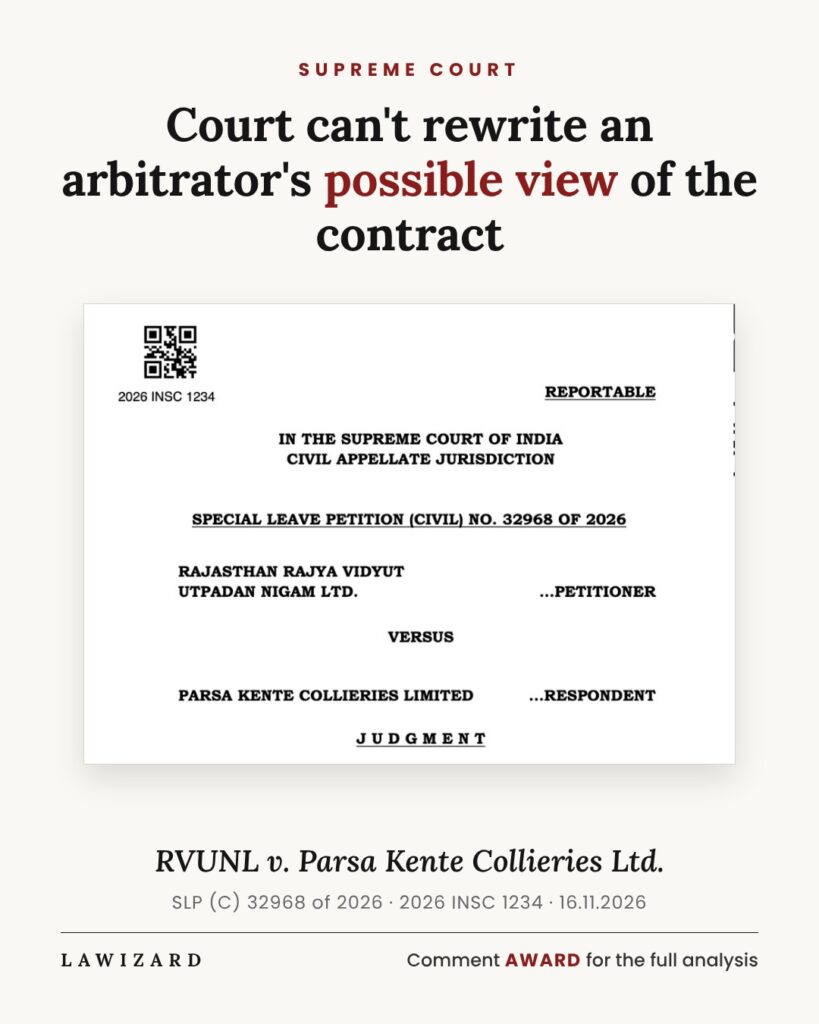
- Case: Rajasthan Rajya Vidyut Utpadan Nigam Ltd. (RVUNL) v. Parsa Kente Collieries Ltd. (PKCL), SLP (Civil) No. 32968 of 2026
- Citation: 2026 INSC 1234
- Bench: Justice Satish Chandra Sharma and Justice Nongmeikapam Kotiswar Singh (judgment by Justice Kotiswar Singh)
- Decided: 16 November 2026
- Law: Sections 33(4), 34 and 37 of the Arbitration and Conciliation Act, 1996; Article 136 of the Constitution
- Result: SLP dismissed; the Award of 15 January 2021 and the Additional Award of 5 July 2021 stand
The dispute
RVUNL, Rajasthan’s state power generator, signed a Coal Mining and Delivery Agreement with PKCL in 2008 to develop the Parsa East and Kanta Basan coal block and deliver coal to RVUNL’s thermal plants. After the Supreme Court cancelled 204 coal block allocations in Manohar Lal Sharma, the block was re-allotted to RVUNL under the Coal Mines (Special Provisions) Act, 2015, and the parties signed a Supplementary Agreement in 2016 to continue the arrangement.
PKCL raised nine claims for unpaid and unreimbursed amounts. A sole arbitrator, Justice Sudhir Kumar Katriar (Retd.), allowed them in an Award of 15 January 2021 and, for one claim he had not decided, an Additional Award of 5 July 2021 under Section 33(4). The claims covered rejected coal rakes, stamp duty on a fresh mining lease, interest on delayed payments, legal costs, bank guarantee charges, compensation for additional project-affected families, a vocational training centre, additional land costs, and interest.
How it went through the courts
- Commercial Court, Jaipur (20 May 2023, Section 34): upheld some claims but found others bad. Holding that it could not modify an award, it set aside both awards entirely.
- Rajasthan High Court (21 May 2026, D.B. Civil Miscellaneous Appeal No. 2007 of 2023, Section 37): allowed PKCL’s appeal and restored both awards.
- Supreme Court (16 November 2026): refused to interfere.
What the Supreme Court held
1. Article 136 review is narrow
In an SLP against a Section 37 judgment, the question is only whether the Section 37 court stayed within its limits. The Court relied on Associate Builders, Ssangyong, Delhi Airport Metro Express and Jan De Nul for the settled limits of review.
2. A possible view of the contract cannot be replaced
“The Arbitral Tribunal is the final arbiter of the facts, and the construction of the contractual terms is primarily its domain.” Where its reading is possible and plausible, the court “cannot substitute its own interpretation, however persuasive the alternative reading may be.”
3. Errors are not enough
Under the proviso to Section 34(2A), an award cannot be set aside merely for an erroneous application of law or by re-appreciating evidence. Patent illegality must go to the root of the matter. The Court said it had not asked whether it would itself have reached the same conclusion (para 48).
4. Claim by claim, the Commercial Court overstepped
- On stamp duty, it read the word “adversely” in isolation from “directly” in the contract.
- On the legal-costs claim, it re-examined the evidence on limitation.
- On the project-affected families and the training centre, both readings were possible, so the Tribunal’s view had to stand.
- On interest, 11.95% simple interest was within the Tribunal’s discretion and was the rate PKCL had claimed; the same rate reflected what RVUNL itself paid its banks.
5. No new case at the last stage
RVUNL could not raise an argument from the Supplementary Agreement that it had not put to the Tribunal. A plea not raised before the Tribunal ought not to have been considered by the Commercial Court either.
6. The Additional Award was valid
Section 33(4) lets a tribunal decide a claim it left out. Limitation was never raised before the Tribunal on that claim, so the Additional Award was not patently illegal for not discussing it.
7. Severability did not arise
Since no part of either award was invalid, the question of severing parts under Gayatri Balasamy v. ISG Novasoft did not arise.
Why it matters
- For Section 34 practice: “the tribunal misread the contract” is not a ground if the reading is a possible one. Show perversity, no evidence, or an illegality going to the root.
- For PSUs and government bodies: every argument must be put to the tribunal. New contractual points cannot be added in court.
- For AIBE and judiciary aspirants: remember Section 33(4) (additional award) and the proviso to Section 34(2A) (no setting aside for mere error of law or re-appreciation of evidence).