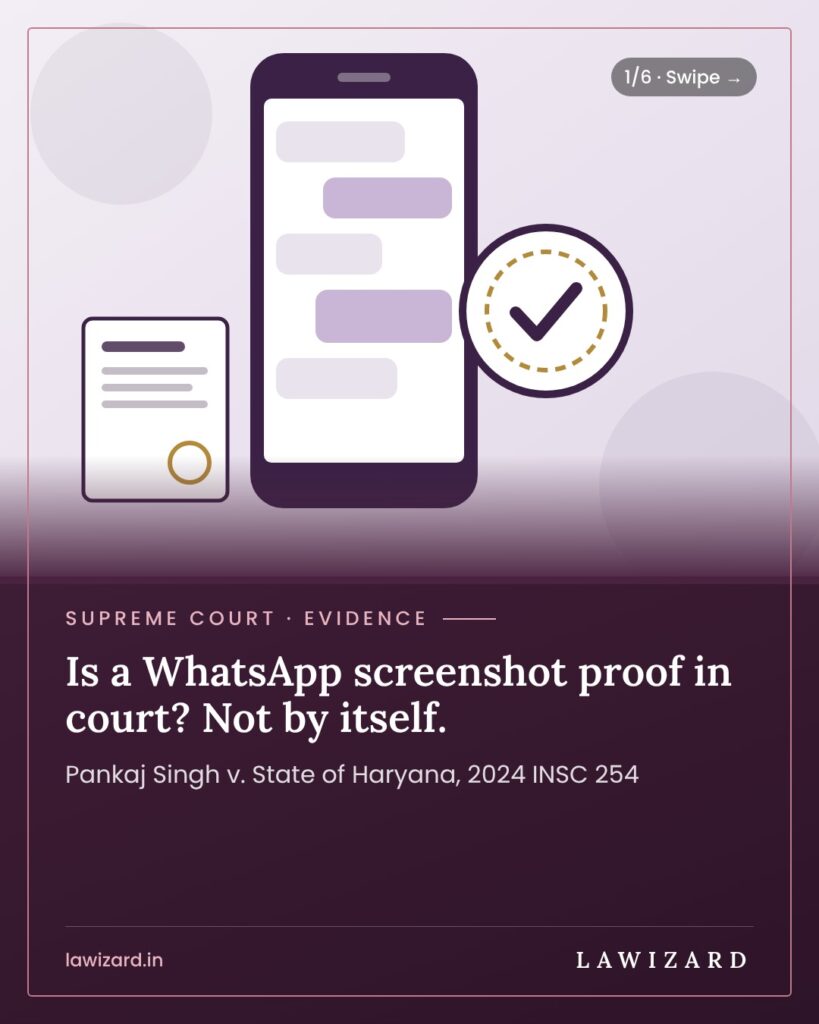
Screenshots of WhatsApp chats are now filed in almost every kind of case: matrimonial disputes, cheating, harassment, recovery suits and criminal trials. But a printout of a chat is not proof by itself. In Pankaj Singh v. State of Haryana, the Supreme Court refused to rely on WhatsApp chats that had come on record without a Section 65B certificate and without the accused ever being asked to admit or deny them.
Read the judgment (PDF, Supreme Court website) →
Case at a glance
- Case: Pankaj Singh v. State of Haryana, Criminal Appeal No. 1753 of 2023
- Citation: 2024 INSC 254
- Bench: Justice Abhay S. Oka and Justice Ujjal Bhuyan
- Decided: 21 March 2024
- Result: Appeal allowed; conviction set aside and the appellant acquitted
What happened
The appellant had been convicted by the trial court, and the High Court upheld the conviction. Before the Supreme Court, counsel for the complainant relied on WhatsApp chats between the two. Counsel accepted that no certificate under Section 65B of the Evidence Act had been produced, but argued that the chats could still be read because of Section 294 of the CrPC (documents whose genuineness is not disputed may be read in evidence without formal proof).
What the Supreme Court held on the chats
1. Section 294 CrPC did not help
Section 294 works only when a document is produced and the other side is called upon to admit or deny its genuineness. Here, the Court recorded that the prosecution did not produce the WhatsApp messages before the evidence began, and that it was “nobody’s case” that the accused had been called upon to admit or deny them (para 21). The argument based on Section 294 had “absolutely no merit”.
2. No Section 65B certificate
The Court also noted that a certificate under Section 65B of the Evidence Act had not been produced (para 21). Since Arjun Panditrao Khotkar v. Kailash Kushanrao Gorantyal (2020), that certificate is mandatory when secondary electronic evidence such as a printout or a copy is relied on.
3. Even an undisputed document is not automatic proof
Even where a document’s genuineness is not disputed, the Court has a discretion whether to read it in evidence (para 21).
On the whole evidence, the Court held that the prosecution had not proved guilt beyond reasonable doubt, and acquitted the appellant (para 22).
The law today: BSA and BNSS
Pankaj Singh was decided under the old laws. From 1 July 2024 the same questions are governed by the new codes:
- Section 63, Bharatiya Sakshya Adhiniyam, 2023 replaces Section 65B. A certificate is still needed for electronic records, now in the form set out in the Schedule to the Adhiniyam: Part A is signed by the party producing the record and Part B by an expert.
- Section 330, Bharatiya Nagarik Suraksha Sanhita, 2023 replaces Section 294 CrPC. The parties must be called upon to admit or deny each document filed, now within thirty days of supply (the court can relax this for recorded reasons). Only where genuineness is not disputed may the document be read in evidence without formal proof.
Practical checklist for WhatsApp evidence
- Keep the original device. The phone that holds the chat is primary evidence. Do not reset or sell it.
- Get the certificate. Printouts, screenshots and pen-drive copies need the Section 63 BSA certificate (Section 65B for older proceedings), signed as the Schedule requires.
- Export, do not just screenshot. Use WhatsApp’s “Export chat” so the full thread, dates and times are preserved, and keep the file unaltered.
- File it at the right time. Put the chats on record before evidence begins and ask that the other side be called upon to admit or deny them under Section 330 BNSS.
- Prove who sent it. Link the number to the person: call records, the SIM subscriber, or an admission.
- If you are opposing chats, object to a missing certificate at once, deny genuineness specifically, and point to gaps or edits in the thread.
For students
Remember the sequence: electronic record, then certificate (Section 65B, now Section 63 BSA, per Arjun Panditrao Khotkar), then admission or denial (Section 294 CrPC, now Section 330 BNSS), then the court’s own assessment of what the record proves.