
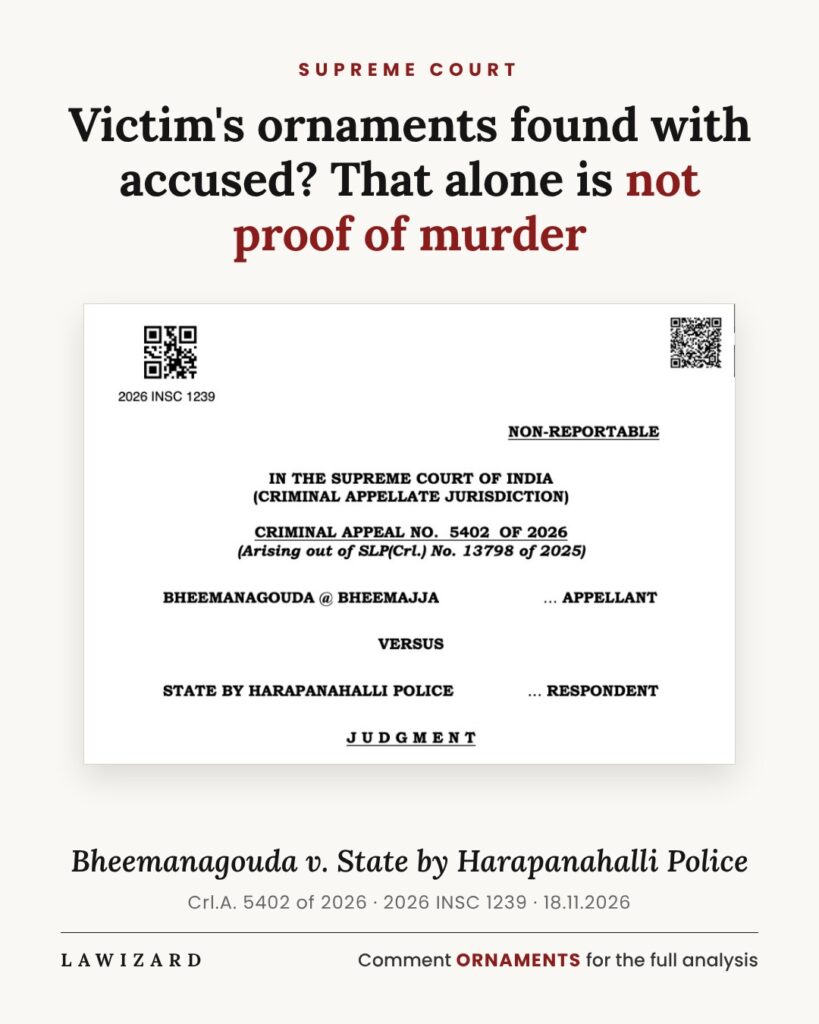
Gold and silver ornaments of a murdered woman were recovered from the accused’s house. Two courts treated that recovery, along with “last seen” evidence and a supposed motive, as enough for a murder conviction and a life sentence. In Bheemanagouda @ Bheemajja v. State by Harapanahalli Police, the Supreme Court has acquitted him. Unexplained possession of a dead person’s belongings allows a presumption of theft, not of murder.
Case at a glance
- Case: Bheemanagouda @ Bheemajja v. State by Harapanahalli Police, Criminal Appeal No. 5402 of 2026 (arising out of SLP (Crl.) No. 13798 of 2025)
- Citation: 2026 INSC 1239 (non-reportable)
- Bench: Justice Prashant Kumar Mishra and Justice Vipul M. Pancholi (judgment by Justice Pancholi)
- Decided: 18 November 2026
- From: Karnataka High Court, Criminal Appeal No. 1355 of 2017 (decided 9 July 2024), arising from Sessions Case No. 101 of 2014, Davanagere
- Result: Conviction under Section 302 IPC and life sentence set aside; acquittal under Section 201 IPC maintained; release ordered forthwith
The facts
In 2013, a woman’s body was found in an iron drum in Harapanahalli, Karnataka. The prosecution said the accused, who allegedly had a relationship with her, strangled her and took her ornaments, and that he later led the police to his house, where the ornaments were recovered. The trial court rejected the “last seen together” witnesses because their statements were recorded after an unexplained delay of 58 days, but still convicted him for murder on the strength of the recovery. The High Court upheld the conviction and relied on the “last seen” evidence as well.
What the Supreme Court held
1. Motive was only guesswork
General talk of an illicit relationship is not proof of a motive to kill. No witness had personal knowledge of any quarrel or suspicion, so the motive remained conjecture.
2. “Last seen” evidence was weak
The High Court did not explain why it accepted witnesses whom the trial court had disbelieved for the unexplained 58-day delay. “Last seen together” alone, without close and independent corroboration, does not prove guilt.
3. The recovery itself was doubtful
One panch witness was not examined, the others did not speak to the disclosure statement, and one admitted that the seizure memo was written as the investigating officer dictated. The requirements for a recovery under Section 27 of the Evidence Act (now the proviso to Section 23(2) BSA) were not met.
4. Possession of the deceased’s ornaments is not proof of murder
Relying on the three-judge bench in Sanwat Khan v. State of Rajasthan, reaffirmed in Raj Kumar @ Raju v. State (NCT of Delhi), the Court held that unexplained possession of stolen articles of the deceased “merely enables a presumption under Illustration (a) to Section 114 Evidence Act regarding theft or receipt of stolen property”. Without cogent evidence that the theft and the murder were one transaction, the recovery “by itself, cannot be stretched to infer guilt of the appellant for murder” (para 13.5).
5. “May be” is not “must be”
Quoting Shivaji Sahabrao Bobade v. State of Maharashtra (para 14), the Court reminded that in a case of circumstantial evidence, the distance between “may be” and “must be” must be covered by proof. The chain of circumstances here was incomplete, and the appellant got the benefit of doubt.
The law today
- Section 27 IEA (discovery on information from an accused) is now the proviso to Section 23(2) BSA.
- The presumption from possession of stolen goods soon after a theft, Illustration (a) to Section 114 IEA, is now Illustration (a) to Section 119 BSA.
- Murder under Section 302 IPC is now Section 103 BNS.
Why it matters
- For defence lawyers: attack every link: motive, “last seen”, the disclosure and the recovery witnesses. A recovery with tainted panch witnesses can collapse.
- For prosecutors: to use a recovery for murder, show that the theft and the killing were one transaction.
- For students and AIBE: recovery of the victim’s goods points to theft (Section 114 Illustration (a) IEA, now Section 119 BSA), not automatically to murder; and the five “golden principles” of circumstantial evidence from Sharad Birdhichand Sarda still apply.