

The Supreme Court has agreed to reconsider one of the most consequential — and most criticised — interpretations under India's drug law: how the quantity of a narcotic is to be measured for the purpose of deciding whether a case involves a "small", "intermediate" or "commercial" quantity. Issuing notice in Mayank Girishbhai Shah v. Union of India (Writ Petition (Civil) No. 816 of 2025), a Bench of Justices M.M. Sundresh and N.K. Singh has indicated that the 2020 three-judge Bench decision in Hira Singh v. Union of India will have to be reconsidered in detail. Because the answer decides both the length of the sentence and the near-impossibility of bail under Section 37 of the NDPS Act, the outcome could affect a very large number of pending narcotics prosecutions.
The question at the heart of the case
Under the Narcotic Drugs and Psychotropic Substances Act, 1985 (NDPS Act), punishment is graded by quantity. A "small quantity" attracts a relatively light sentence; a "commercial quantity" attracts rigorous imprisonment of ten to twenty years and the stringent bail bar under Section 37. The pivotal question is this: when a narcotic drug is found mixed with neutral or inert material, do you weigh the entire mixture, or only the actual (pure) drug content inside it?
That single question can move a case from the "small quantity" bracket to the "commercial quantity" bracket — and with it, a person from probable bail to years of pre-trial custody.
How the law reached this point
The controversy traces back to a Central Government notification dated 18 November 2009, which amended the earlier 2001 notification that had prescribed the threshold quantities for various drugs. The 2009 amendment inserted Note 4, clarifying that the quantities specified for small and commercial categories would apply to the entire mixture, solution or preparation containing the narcotic drug or psychotropic substance — and not merely to its pure drug content.
The validity and effect of that notification became the subject of conflicting Supreme Court authority. In E. Michael Raj v. Intelligence Officer, Narcotic Control Bureau (2008), a two-judge Bench had held that only the actual content of the offending drug in a mixture is relevant for determining the quantity. That taxpayer-friendly — or rather accused-friendly — reading was, however, overruled in 2020.
In Hira Singh v. Union of India (2020), a three-judge Bench upheld the Government's position and Note 4, holding that for classifying a seizure as small, intermediate or commercial, the entire weight of the mixture or solution must be considered, not just the pure narcotic content. Hira Singh has governed the field ever since.
The petitioner's challenge
The petitioner in the present matter, Mayank Girishbhai Shah, brought the issue back before the Court through a concrete and striking example drawn from his own case. His matter involved Ayurvedic medicines. On chemical analysis, the actual opium content was only 74 grams — but because the total mixture weighed over 3.2 kilograms, the authorities treated the seizure as a "commercial quantity". That classification exposed him to the harsher punishment regime and to the stringent bail restrictions under Section 37 of the NDPS Act.
His central arguments were these:
- The NDPS Act itself speaks of the actual drug content, using percentage-based definitions for narcotics such as opium and coca derivatives — not the gross weight of any preparation in which the drug happens to be found.
- When Parliament amended the Act in 2001 to introduce graded, quantity-based punishment, the object was to be lenient towards small users and severe towards traffickers. Counting neutral filler material defeats that object.
- Neutral substances are added to drugs for very different reasons — as a diluent to make a drug consumable, as a carrier, or as a genuine ingredient in a lawful product such as an Ayurvedic medicine. Treating every such mixture identically, he argued, is arbitrary.
- The result is often absurd: a few grams of opium mixed into a large quantity of sugar can be branded a "commercial quantity" carrying ten to twenty years, while a larger weight of pure opium might attract a lesser punishment.
- On these grounds, the rule is said to violate Article 14 (equality) and Article 21 (life and personal liberty) of the Constitution.
What the Court has done so far
The Bench of Justices M.M. Sundresh and N.K. Singh has issued notice and sought responses from the Central Government and the Narcotics Control Bureau (NCB). Importantly, the Court has signalled that the interpretation in Hira Singh will need to be examined afresh and in detail — a clear indication that the settled position is genuinely open to reconsideration rather than a routine notice. The matter is now pending, with the Union and the NCB to file their responses.
Why this matters
The stakes are unusually high for a question that sounds technical. Whether the whole mixture or only the pure content is counted determines:
- Bail. A "commercial quantity" triggers Section 37, under which bail can be granted only if the court is satisfied that the accused is not guilty and is unlikely to reoffend — an extremely difficult threshold that keeps many undertrials in custody for years.
- Sentence. Commercial-quantity offences carry rigorous imprisonment of ten to twenty years and heavy fines; small-quantity offences are treated far more leniently.
- Consistency and fairness. A rule that can convert a small amount of actual contraband into a "commercial" case, depending on how much inert material it is mixed with, raises real proportionality concerns.
Because Hira Singh is a three-judge decision, any reconsideration that departs from it may ultimately require a larger Bench. If the Court eventually accepts the petitioner's view — or restores the E. Michael Raj approach — it could recalibrate the quantity classification in a very large number of NDPS prosecutions across the country.
What to watch
Three things will shape the outcome. First, how the Union Government and the NCB defend Note 4 and the policy behind counting the whole mixture. Second, whether the Court refers the correctness of Hira Singh to a larger Bench, given that it is itself a three-judge ruling. And third, whether any eventual reinterpretation is made applicable to pending and past cases, which would have immediate consequences for bail and sentencing. For now, the significant development is that a long-settled and heavily litigated interpretation has been reopened.
Conclusion
The reference in Mayank Girishbhai Shah v. Union of India revives a debate that goes to the core of how India punishes drug offences: should the law measure the poison, or the packet it comes in? By agreeing to reconsider Hira Singh, the Supreme Court has acknowledged that the question deserves a fresh and careful answer — one that balances the State's legitimate interest in curbing trafficking against the constitutional guarantees of equality and liberty. Until the Court rules, however, Hira Singh remains the governing law, and the entire mixture continues to count.
Annexure: The Supreme Court record
Set out below is the Supreme Court’s Record of Proceedings dated 1 September 2025, by which the Court allowed the petitioner’s application to file additional documents and issued notice. It is followed by a faithful reproduction of the Registry’s Office Report of Fresh Case, which records the reliefs sought in the writ petition.
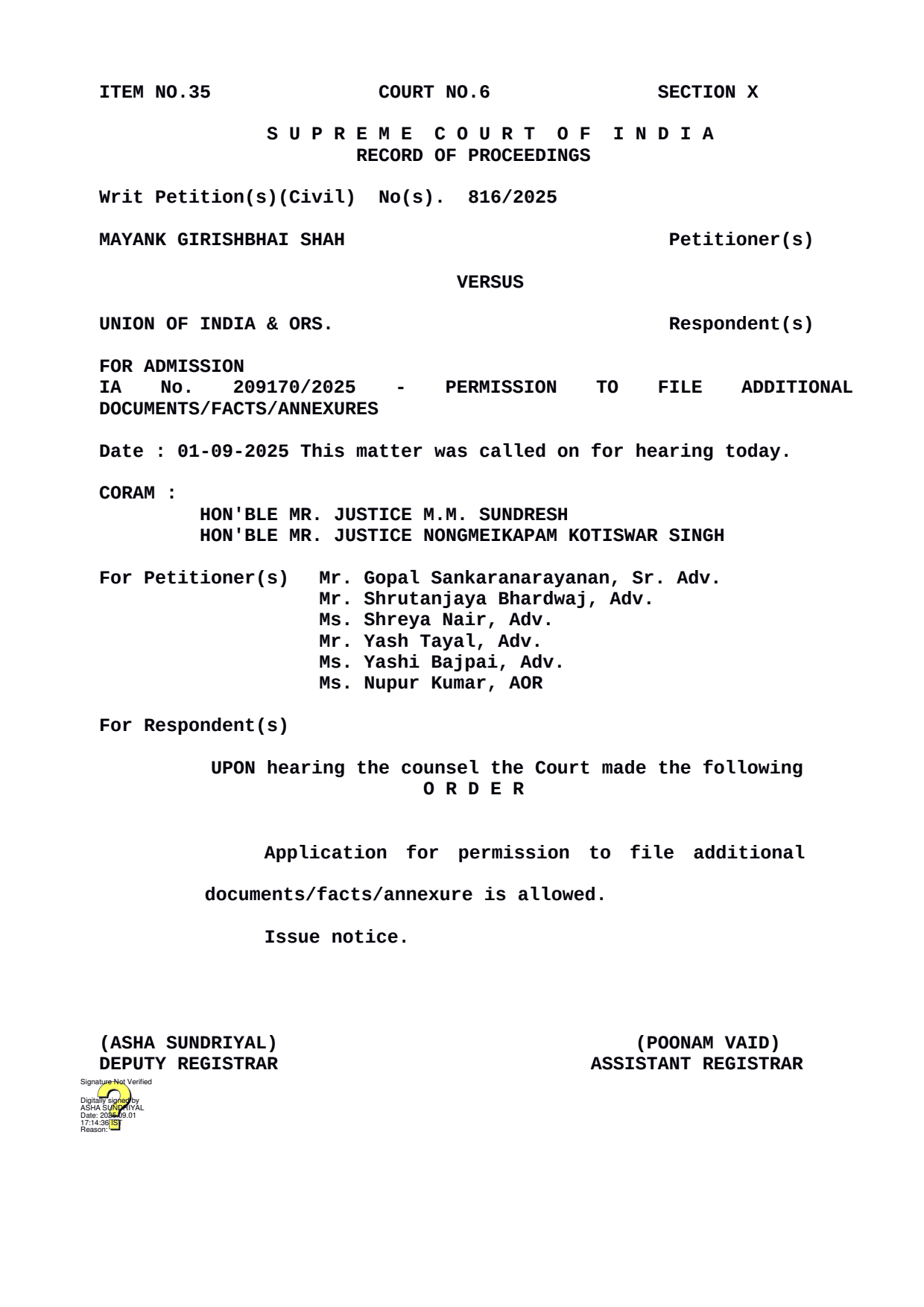
Record of Proceedings, Writ Petition (Civil) No. 816/2025, dated 1 September 2025. Open full image.
Registry Office Report of Fresh Case (reproduced)
Listed On: 01-09-2025 | Court No.: 6 | Item No.: 35
SUPREME COURT OF INDIA — CIVIL ORIGINAL JURISDICTION
Writ Petition (Civil) No. 000816-000816/2025, with Interlocutory Application No. 209170/2025 (Process Id: 1906/2025)
Mayank Girishbhai Shah … Petitioner(s) versus Union of India and others … Respondent(s)
OFFICE REPORT OF FRESH CASE
1. This Writ Petition has been filed by Ms. Nupur Kumar, Advocate-on-Record, on 25-08-2025, praying therein as under:
a) Issue a declaration that Notification No. S.O. 2941(E) published by the Ministry of Finance, Department of Revenue dated 18.11.2009 is void for being ultra vires the NDPS Act and unconstitutional, and quash the same;
b) Issue a declaration that for the purposes of the offences under the NDPS Act, 1985, the quantities mentioned in Notification No. S.O. 1055(E) dated 19.10.2001, i.e. “small quantity” and “commercial quantity”, shall be reckoned with reference to the pure drug content in any seized substance and not the total weight of the substance / mixture / preparation; and
2. The Advocate-on-Record for the petitioner has also filed the following interlocutory application: I.A. No. 209170-2025 — “Permission to file additional documents / facts / annexures” (filed 26-08-2025).
3. The similarity found in the present case is based on: SLP (Crl.) Diary No. 9472-9473/2025, Mayank Girishbhai Shah vs. Narcotics Control Bureau and Anr. — dismissed on 03-07-2025 (referred to at page 21; Annexure p-21, page no. 427, filed by the petitioner).
4. It is submitted that counsel for the petitioner has, on 26.08.2025, filed an application for permission to file additional documents along with additional documents in which some of the pages are in dim impression / small font. However, copies of the same are being circulated before the Hon’ble Court for kind perusal.
5. The writ petition along with the application(s) above mentioned is listed before the Hon’ble Court with this Office Report.
Date: 29-08-2025 — Assistant Registrar
The image above is rendered from the Supreme Court’s official Record of Proceedings in this matter. The Office Report is reproduced faithfully from the Registry’s record for readability.
Authored by Akinchan Aggarwal
B.A. (Hons.) Gold Medalist, LL.B. (Silver Medalist), LL.M. (Dispute Resolution)
Advocate, Punjab and Haryana High Court
This article is for general information only and does not constitute legal advice. As the matter is pending before the Supreme Court, readers should follow further developments and refer to the official record for the precise orders and the eventual decision.
